
Nodal analysis calculator with steps
Updated
Draw your circuit, choose Node Voltage and Nodal Analysis, and Circuitsteps solves it step by step: the KCL equation at every node, the matrix they form, and every node voltage.
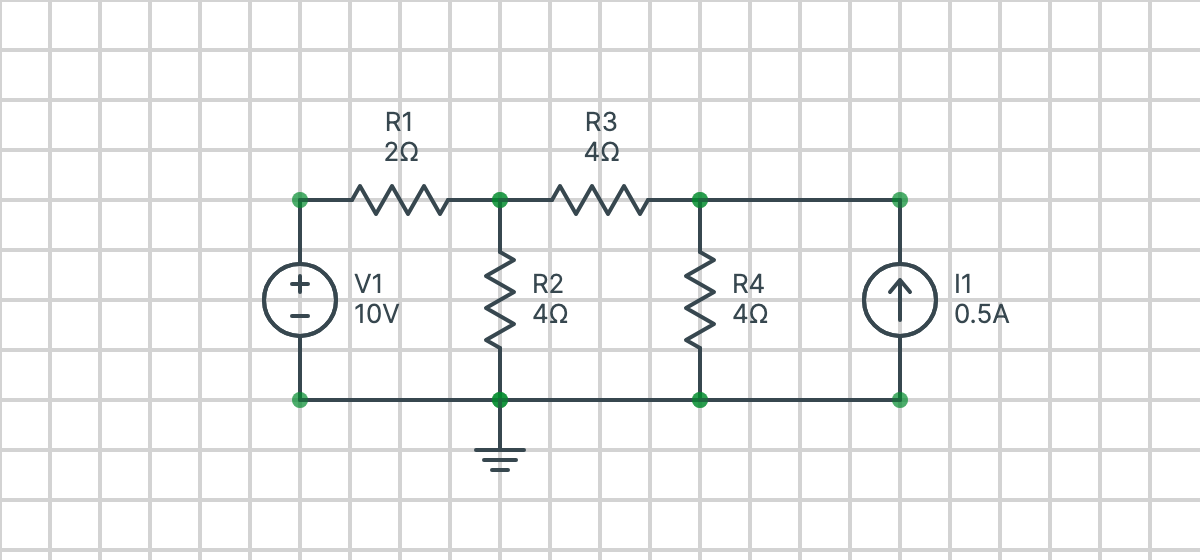
Edit the circuit above, or draw your own, then select Solve step by step.
How to use the nodal analysis calculator
- Draw the circuit. Choose a part from the toolbar, then click and drag on the grid to place it. Connect the parts' ends, using wires where you need them.
- Enter the values. Double-click a part to change its value, such as or . Prefixes like k and m work too.
- Place a reference node (the ground symbol). Node voltages are measured from it.
- Choose what to solve for: every node voltage, or just one node.
- Choose Nodal Analysis and solve.
What the solution shows
- A KCL equation for each node, with the current through every component written in terms of node voltages.
- Supernodes, where a voltage source connects two nodes, with their constraint equations.
- The equations simplified and written as a matrix.
- The matrix solved, giving each node voltage.
- If you ask for them, the branch currents and the voltage across each component, worked out from the node voltages.
What it can solve
Circuits with resistors, independent voltage and current sources, dependent sources, and capacitors and inductors at DC (where a capacitor is an open circuit and an inductor is a short circuit). As well as node voltages, it can find branch currents, mesh currents and the voltage across any component, with nodal or mesh analysis.
Example
In the circuit above, a source sets node 1, and a current source feeds node 3. The calculator writes KCL at nodes 2 and 3, adding up the currents leaving each node:
Simplified, these are and , which give
Solve this example in Circuitsteps to see every step.
Nodal or mesh analysis?
Nodal analysis finds node voltages using KCL, and is usually quickest when a circuit has more meshes than nodes, or has current sources. Mesh analysis finds mesh currents using KVL, and is usually quickest when it has fewer meshes than nodes, or has voltage sources. Circuitsteps can solve for any value with either method.
Frequently asked questions
Is the nodal analysis calculator free?
Yes. Circuitsteps is free to use, with no sign-up.
Does it show the steps?
Yes. It shows the KCL equation for each node, the equations simplified, the matrix they form, how the matrix is solved, and every node voltage. It can also go on to find the branch currents and the voltage across each component.
Do I need to place a reference node?
To find node voltages, yes, as they are measured from the reference node. To find branch currents, mesh currents or the voltage across a component, Circuitsteps picks a reference node for you if there isn't one, as the answers don't depend on it.
Can it solve circuits with dependent sources and supernodes?
Yes. Dependent voltage and current sources can depend on the voltage across, or the current through, another component, and voltage sources between two nodes are handled as supernodes automatically.
Does it work on a phone?
The circuit editor needs a larger screen, so use it on a laptop or desktop computer.