
Kirchhoff's law calculator (KCL and KVL) with steps
Updated
Draw your circuit and Circuitsteps applies Kirchhoff's laws for you, step by step: KCL at every node with nodal analysis, or KVL around every loop with mesh analysis. You get every equation, the matrix they form, and the current through and voltage across every component.
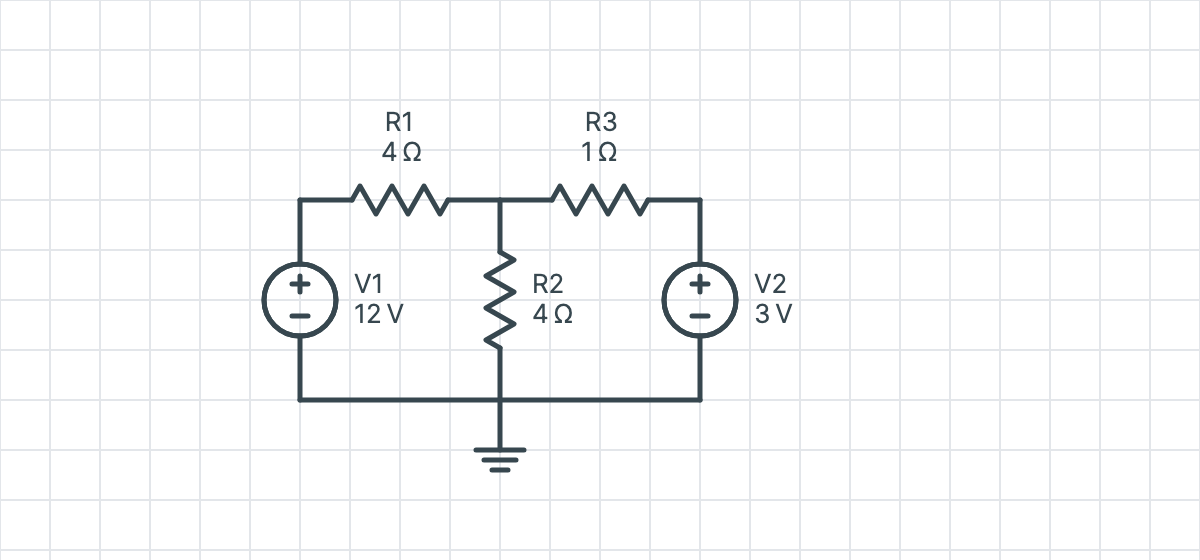
Edit the circuit above, or draw your own, then select Solve step by step.
How to use the Kirchhoff's law calculator
- Draw the circuit. Choose a part from the toolbar, then click and drag on the grid to place it. Connect the parts' ends, using wires where you need them.
- Enter the values. Double-click a part to change its value, such as or . Prefixes like k and m work too.
- Place a reference node (the ground symbol) if you want node voltages. Branch currents and component voltages don't need one.
- Choose what to solve for: Node voltages, Branch currents (the current through each component), Mesh currents or Component voltages, for every one or just one.
- Choose the method. Nodal analysis writes the equations with KCL, and mesh analysis writes them with KVL. Then solve.
Kirchhoff's laws
Kirchhoff's current law (KCL) says the currents flowing into a node add up to the currents flowing out. Equivalently, the sum of the currents leaving a node is zero:
Kirchhoff's voltage law (KVL) says the voltages around any closed loop add up to zero: the rises equal the drops.
Together with Ohm's law, , they're enough to solve any circuit of resistors and sources. The question is just how to organise the equations, and that's what nodal and mesh analysis are:
| Method | Unknowns | Equations | Number of equations |
|---|---|---|---|
| Branch currents | The current in every branch | KCL at nodes, and KVL around loops | One per branch |
| Nodal analysis | Node voltages | KCL at each node | One per node, less the reference node |
| Mesh analysis | Mesh currents | KVL around each mesh | One per mesh |
Nodal and mesh analysis need fewer equations than writing KCL and KVL for every branch, which is why Circuitsteps uses them. Both give every branch current in the end.
Example: KCL and KVL by hand
In the circuit above, a source and a source are joined by () and (), with () down the middle. Find the current through each resistor.
Step 1: label the branch currents
Let flow right through , flow down through , and flow right through . If a guess is the wrong way round, its answer just comes out negative.
Step 2: KCL at the top middle node
flows in, and and flow out:
Step 3: KVL around each loop
Clockwise around the left loop, up through , right through and down through :
Clockwise around the right loop, up through (against ), right through , and down through from its + end to its − end:
Step 4: solve
Substitute into the first loop's equation to get . The second gives , so :
The node between the resistors is at . Checking with the outer loop: drops and drops , and , which is .
Solve this example in Circuitsteps to see the same answers found with nodal analysis (one KCL equation) or mesh analysis (two KVL equations).
What it can solve
Circuits with resistors, independent voltage and current sources, dependent sources, and capacitors and inductors at DC (where a capacitor is an open circuit and an inductor is a short circuit). It handles supernodes and supermeshes automatically, and finds node voltages, mesh currents, the current through each component and the voltage across each component.
Tips for using Kirchhoff's laws
- Pick a sign convention and stick to it. For KCL, add up the currents leaving each node. For KVL, add up the drops as you go round, and count a source as negative when you go through it from − to +.
- Don't worry about guessing directions. A current or voltage that comes out negative just goes the other way.
- You only need independent loops. In a planar circuit, the meshes (each enclosed window of the drawing) are always enough. Extra loops just repeat information.
- Check with a law you didn't use. KCL at a node you skipped, or KVL around the outer loop, should hold with your answers.
Frequently asked questions
Is the Kirchhoff's law calculator free?
Yes. Circuitsteps is free to use, with no sign-up.
Does it use KCL or KVL?
Both, depending on the method you choose. Nodal analysis writes a KCL equation at each node, and mesh analysis writes a KVL equation around each mesh. Either way you get every equation, the matrix, and the answers.
Can it find the current through every resistor?
Yes. Choose Branch currents to get the current through each component, or Component voltages to get the voltage across each one, and it shows how each is worked out.
What is the difference between KCL and KVL?
KCL (Kirchhoff's current law) says the currents leaving a node add up to zero. KVL (Kirchhoff's voltage law) says the voltages around a closed loop add up to zero. KCL is the basis of nodal analysis, and KVL is the basis of mesh analysis.
Does it work on a phone?
Yes. On a phone or tablet, Circuitsteps has a touch editor: tap a part to add it, drag to move it, and tap Solve step by step.